Wednesday, February 8, 2023

 The HORSE DRAWN Papers #7

A   R E T R O S P E C T I V E

The following is pages 141 to 142 extracted from an unattributed article from Alexandria and St. Albans Township (1952).

When Phineas Ford with his wife and family were pushing through the forests on their way from Frankinton (now Columbus) to a spot in what is now Union Township in April 1800, they passed through the southern part of our present St. Albans Township.  Their only help in seeking out a home in an entirely unsettled region was a pocket-compass and a map of this part of the Ohio Company's lands.  Their worldly possessions were all packed in a wagon drawn by an oxteam.  The first day out of Franklinton a wheel of their wagon broke under the strain of hard traveling.  Mr. Ford made some felloes for the wheel, it is recorded, from a crooked dogwood, screwed on the tire and started on again.  The next day a member of the party thrust his gun into a wheel to save the wagon from turning over and broke the stock off his gun.  When coming down a steep bank on Mootz Run, probably where the old trail crossed the stream on what is now Forsyth land, a grape vine caught under the oxen, and the of the wagon drove them forward with such impetus that is swung the cattle from the ground until relieved by cutting the grapevine.

In 1815, Lewis Martin and family and several relatives were on their way from Charleston, Va., to Jersey township where Martin had already built a cabin.  They got as far as Mootz Run where they had to cut out a wagon road before they could proceed with their teams.  Mr. Martin and his company were assisted in cutting out a wagon track by Joseph Headley and the colored [sic] in his employ.  They left the Worthington Road on what was later Spellman or Forsythe land.  The first day in opening the road they came to a point on Mootz Run where the Jersey road first crossed it, probably just below the present covered bridge.  On the second day they succeeded in cutting their way through to their new homes, all moving into the cabin on the 15th day of June 1815.

Wickliff Condit and his wife of Morristown, New Jersey, when migrating to Jersey Township in 1819 arrived at Blood's Tavern on the road from Granville and Alexandria on June 6, stayed all night, left their baggage as security for payment for lodging and walked to Jersey on the 7th.

An example of the Conestoga wagon.  The front axle is lower front axle.  Smaller wheels in front means tighter turns and the inclusion of the "lynch" or king pin necessitates more wood bolstering the front.

Although the simpler means of transportation already described really did the first work of opening up the overland trails for the onrush of settlers, it is the lynch-pin Conestoga or "covered wagon" of a slightly later period which has somehow come to be the symbol of America's great movement of western expansion.  St. Albans knew the lynch-pin wagon best in te 1830's and 1840's.  At least two of St. Alban's township's highways developed early into transcontinental emigrant routes.  The old Delaware road and the Worthington Road were among the most traveled routes for settlers seeking the west and northwest during the first fifety years of the last fifty years of the last fifty years of the last century, partially because, no doubt, because there were no toll gates on these highways.  The Worthington Road, the present Route 161, was an important emigrant route as early as 1805, early maps of the state reveal.  Several decades preceding the Civil War period, caravans of covered wagons in steady succession were probably the most conspicuous feature of St. Albans highways during the seasons of the year when travel was at all possible.  Needless to say, the taverns which sprang up along these routes, nearly as thick as filling stations today, did a thriving business.

The lynch-pin wagon continued as a much-used vehicle for many years, for local as well as for cross country travel.  [...]

Locally, there was of course much recourse in early years to oxcarts and sleds and particularly horseback for transportation.  The young swain very commonly took his best girl on horseback and Dobbin was made to carry "twice".  Buggies were being manufactured in a limited way at this time, but few were in general use.  Wagon travel was common.  When the family went traveling in one of these early wagons, either the kitchen chairs were brought into use for seats or improvised wooden springs.  One method of shock absorbing was by means of two hickory poles about two and a half inches in diameter suspended by iron hooks over the sides of the wagon body, one on either side with seat boards covered with bed blankets resting on the poles.  In this manner comfort in riding was greatly improved.

In the late 40's and early 50's buggies began to come into common use.  The earliest of these were clumsy, heavy affairs with wooden axles, wheels as heavy as those on a light one-horse wagon today, and rigid tops fastened to a post at each at each corner of the body, but with steel springs, a great advance over the wagon for the convenience in travel.  In the 50's these vehicles were greatly improved by means of iron axles, lighter wheels, and more shapely bodies.  Spring wagons also appeared at this time for taking the family.  In the 60's came the lighter one-horse buggy with an adjustable top similar to those of the present day.  The body from the seat to the floor of the buggy in the rear was a direct slant like the roof of a house.  In the early 70's came the buggy with a "boot" body, followed in the later 70's with the "piano bed" body which is still with us.

In the 70's also, for light business driving, the "skeleton wagon" was quite commonly used.  This vehicle had no body, simply the gears, a slatted floor, a seat resting on half elliptic springs.  In the 80's carts for the same purpose were popular.

Tuesday, February 7, 2023

 The HORSE DRAWN Papers #6

T h e   L I V E R Y

One of the more iconic features of the horse drawn world is the Livery Stable.  It is probably what we think of when we think of the Horse Drawn world.  In an 1881 edition of the local magazine. Church and Home, the following advertisement appeared,

G. P. Walrath

Livery and Feed Stable

Alexandria, Ohio

I   have   New   Buggies   and   Good   Horses,

and  am  prepared  to  wait  on  customers  at

all hours. Terms Reasonable. Satisfaction guar-

anteed.  Give me a call

The Walrath family were farmers and ran a Livery and Feed Store.  I have found no further reference to this facility in village plats, but at this time, the village did not include the extension on Main Street from the Baptist Church to Northridge Road, or the Granville Street extension.  It is then entirely possible this livery was located by the Toledo & Ohio Central Depot, outside of town.

When the Great Fire of 1905 destroyed the downtown business block in Alexandria, one of the casualties was the Procter Brothers Blacksmith Shop.  A "fireproof" livery made of block replaced the wooden smith shop.

What is a livery?  In modern parlance, it refers to a common paint scheme used across the company's fleet.  We instantly recognize Delta Airlines, or Checker Cab, or even a Wal-Mart bag.  In the late 1800s, a livery was a place which catered to horses.  Here, you could rent or buy horses, carriages, harnesses, lamps, or other accoutrements.  You could also buy feed.  This was a sort of Wal-Mart in the horse world.  Often liveries would operate horse-drawn taxis or busses.  During this time, most schools were within walking distance of the students, school busses were not a thing until after 1900.

A view of North Liberty Street of the E. H. Hammond.  (Yes, the photo incorrectly states North Main Street) A livery bus/hack can be seen parked on Church Street.

The Hammond family was prolific in St. Albans.  E. H. Hammond operated the new livery built after the Great Fire of 1905.  The new livery was built where the Proctor Brothers had operated a blacksmith shop at the southwest corner of Church and North Liberty Streets.  The Boudinot house was on the other side of North Liberty to the right of this picture.  Edmond Hammond was a local guy whose family made their money in the northwestern corner of St. Albans' as farmers.  Edmond wanted to be a businessman.  I cannot discern if Hammond absorbed any of Shrader's business, inasmuch as this is concurrent with Shrader's removal to Monroe Township.  The building is still there.

Edmond was born to John and Clara (Webb) Hammond.  The Hammond family migrated Sussex, England, to New Jersey, where they remained for a few generations before coming to Alexandria.  Edmond was born in St. Albans Township on November 10, 1877, and died in St. Albans on November 12, 1951.  Edmond married Esther Johnson in 1905, and they had two children, Keith and Annabelle.  Sadly, Annabelle died in 1932.

In the early Summer of 1902, The Johnstown Independant listed Ed. Hammond as the owner of a livery stable.  No indication of the location of the business is mentioned.

At some point, the building was sold to St. Albans Township to serve as their garage and workshop for snowplows and tractors with mowers.

St. Albans Township Garage from the approximate position as the photo of the livery. (2019)

Today, the gas station serves as the closet relative of the livery.  But the reality of the two do not compare.  A livery might run a taxi or a bus.  You could rent a horse, a buggy, or both.  You could pick up feed and grain, although the miller might have a better deal.  You might be able to get a harness or harness equipment.  Small hardware such as buckles might also be had there.  It all depended on local needs.

By the time Edmond sold or closed his business, the town had three gasoline stations, on just a short, one-minute walk away.  In the 40 or 50 short years since the first automobile appeared in St. Albans, the way of the horse was over.  Today, as agriculture is supplanted by country housing, small stables are popping up all over.  Lobdell Park, a converted farm, offers horse trails which prove quite popular in warmer temperatures.  Even so, the horses arrive in trailers pulled by heavy duty pick-up trucks.  It is an irony.

Monday, February 6, 2023

The HORSE DRAWN Papers #5

T h e   M E R C U R I A L   M.   D.   S H R A D E R

The name M. D. Shrader consistently appears in Alexandria's history in the late 1800s through the Great Fire of 1905, then promptly disappears.  It took some research to find out more about Mac.

Mac, as I shall call him, came from a very German, Revolutionary War family.  For reasons now lost, after a long series of Germanic names, the Shraders named their son MacKindra Douglas Shrader, a very Scottish name.  Mac went into business as M. D. Shrader and was active in the Republican party.  Mac lived on Church Street near North Liberty Street with his business on the opposite side at least an alley west between his house and work.  The picture of Buxton's 'Old Red' Tavern shows a wooden structure along Church Street... it might be Mac's.

Trains need wood or coal.  The future automobile will need petroleum.  While horses can graze, but as good stewards, we feed them in order to keep horses healthy.  Initially, it appears as if Mac ran a food and grain store.  I am not as familiar with horses as I would have liked to be, but I know there are riding horses, team horses, buggy horses, draft horses, and a pony for your daughter.  Along the way, there are also mules and donkeys.  These equines all need tended and fed.  At the same time, a Mr. Latham appears to have owned a feed and grain store as well.


Because little documentation exists, this may belie two grain stores or a succession of business.  By 1902, M. D. has an advertisement in the Johnstown Independant as a dealer in "agricultural implements, stoves, windmills, buggies, wagons, harnesses, etc." while John D. Loyd, a Welsh immigrant, handled "wool, poultry, seeds, grains, produce, etc."  But, in 1900, Mac had sold some property to the Alexandria Harness Company.

For reasons not entirely clear, by 1910 Mac and his family removed to Monroe Township.  This most likely was the result of the disposition of his parents' farm.  With this move, Mac disappears from Alexandria and St. Alban's history.  M. D. died on April 10, 1926, and is buried at Green Hill Cemetery in Johnstown.  From Mac's obituary we learn that he was elected Mayor of Johnstown for several terms, when he suffered a substantial stroke and died the following evening.


With all the mentions in Alexandria's history, Mac's role has been difficult to track.  Mac is on my radar...

 The HORSE DRAWN Papers #4

T h e   B L A C K S M I T H

I never knew C. D. Maranville, but I spent my teen-age years in his house.

Charlie Maranville's house as it appears today. (Edited)

Everyone needed a blacksmith.  The problem is that today, no one really knows what the blacksmith did.  We know from pictures that it involves fire, steel or iron, an anvil, and a hammer.  We may have wanted decorative hinges, or a wrought iron fence, or nails.  Maybe your horse needs new shoes...

What we need to remember is that outside of industrial wagon factory, the wagonmaker had to have an integral knowledge of smithing in order to fit irons and the blacksmith needed to know a thing or two about wagons, more than likely, he needed to know how to put a new tire on a wagon wheel.

Charlie Maranville was Alexandria's blacksmith, or so I thought.  In an 1866 Alexandria Business Directory lists Charlie as a maker of carriages, turning, and trunks.  By the 1870 Federal Census, Charlie is listed as a Journeyman Halter Maker.  In the 1880 and 1990 Federal Censuses, he continues as a harness maker.

Little is known of him beyond his vital statistics.  We know he was born on June 8, 1836.  We just don't know where, some say New York, some say New Jersey, others say Ohio.  We do know he died on April 11, 1904, and is buried in Alexandria's Maple Grove Cemetery.   Charlie married Julia A. Twining, whose history is more definitive.  Julia was a local girl and is listed in Alexandra and St. Alban's Census Records from 1850 on.  In her final years, she lived in Newark with her son on Robbins Drive.  She died in the Newark Hospital from a severe stroke on July 1, 1919, and was buried beside her husband two days later.

Frank Maranville's house on Robbin Drive where Julia spent her final years.

Charlie is listed as a harness or halter maker in the 1870, 1880, and 1900 Census records. (The 1890 Census was lost to fire.)  By comparison, Alexandris had six blacksmiths in 1870.  By 1880, there were twice as many, and by 1900, eight blacksmiths were still available.  Charlie and Julia had two sons, Frank W. and Fred C. Maranville.  Frank moved to Newark near the Rugg factory while Fred remained in Alexandria.  Downtown Alexandria seemed full of craftsmen.  In fact, in 1880 one of Julia's brothers was listed as a tinsmith as was his neighbor John Scuraman.

So, was Charlie a blacksmith?  I just don't exactly know.  While this is possible, it appears that in the latter half of his life, Charlie worked leather into harness.  What I do know is that Alexandria needed a blacksmith and by 1880, the village had three blacksmiths and four journeymen blacksmiths.  All I know about Charlie is that I don't know much.

Saturday, February 4, 2023

The HORSE DRAWN Papers #3

T h e   H A R N E S S   S H O P

In a horse drawn world, two articles are vital.  To ride a horse, a bridle and saddle is all but required.  To harness the power a horse provides, a harness is required.  In deference to Dr. Franklin Peques, Professor Emeritus of History at the Ohio State University, the good doctor often stated the greatest invention of the Mediaeval World was the stirrup.  The stirrup allowed the knight to control his horse with his feet while wielding weapons with his hands.

A horse's harness can be complicated.

Alexandria, incorporated by Alexander Devilbiss (Dee-ville-bis) had two fledgling cottage industries on its inception, the cooperage and the rope maker.  The cooper made barrels, the most common shipping container of the day.  The rope maker made hemp ropes which were vital to farm society, especially those with cattle.  There was probably one or two who specialized in rope weaving allowing broken ropes to be repaired.  As farms were cleared for and by the horse and plow, good, old-growth wood became readily available.  Alexandria and St Alban's were wood-rich.  As the wood supply dried up, the coopers moved on.  The rope makers remained.  Eventually, their business would expand into harness-making.

One of the first mentions of rope making in Alexandria is a rope factory built by Alexander Devilbiss in the back of Lot 20. Very early on, a rope bridge over the Raccoon Creek was made along what today is Tharp Road. This rope bridge was in existence in the early 1900s and is mentioned in The Buxton Journal. Then it was the South Road; today, it is SR 37.

An 1800s Alexandria farm and business family was the Boudinots. In 1866, Elisha Boudinot owned the farm northeast of Alexandria and by 1875, extended it to the highland along the east side of Mounts Road. Elisha also owned properties in Alexandria. These include the lot where the firehouse currently stands, although in 1866, there was a house there. He also owned the lot across the street. On this lot, there was a house on the west side of the lot and a harness shop on the east half of the lot. Elisha also owned a large house on the east side of North Liberty across from the current township garage.

Elisha Boudinot got his start growing hemp. With so much farmland devoted to staple crops - often with so much excess of grains that it was converted to whiskey and rye - Boudinot could afford to grow hemp and buy flour. Boudinot would dry the hemp and work it into fiber with which to weave rope. It is not clear if this led Boudinot into the leather business or if he stuck to rope, but we do know Boudinot & Oldham's merchant store offered custom shoes.

Then we have the record of L.S. Chadwick, the hardware merchant, who recalls "Mr. Blizzard and John Reid" as harness makers some time earlier.

The Blizzard family immigrated to Licking County from Pittsburgh at some time in the early 1800s. The 1840 Federal Census of St. Albans Township lists M. (Mervin) E. Blizzard, a single male between 20 and 29. By 1850, M. E. Blizzard, had married, moved to Monroe Township, and is raising a family with his wife Louise Reed. The couple would go on to have six children, none of whom remained in Alexandria. His occupation is "Saddler" as was his partner, John Reid. By 1870, M.E. Blizzard lived in Wauseon, county seat of Fulton County just a few miles south of Michigan, where he is a harness maker. John Reid (also spelled as Reed and Read) was married to Mary M. ________. In 1850, John and Mary had no children. By 1880, John and Mary had a 20-year-old son named Johnnie who worked as a store clerk. John was listed as a farmer.

By this time, Watson Davison was the wagonmaker and seemed to take over for Mr. Marandville who lived more or less across the street at 57 West Main. Through Alexandria family relationships far too lengthy for your patience, we come to Zola Rugg, who married into the Davison family. Zola was the daughter of Elijah 'Lige' Rugg. Lige was the older brother of Ephraim Rugg. We are more familiar with Ephraim by his company's name E.T. Rugg & Co. This company made harnesses in Alexandria.

It is also worthwhile to say that Alta Curtiss was employed by Rugg to sew harnesses.  Alta lost her uninsured millinery business and everything she owned in the Great Fire of 1905.

The Newark Advocate tells us that Ephraim T. Rugg went into business sometime around 1880 when Ephraim was about 25 years old at the time. Some sources indicate that harness-making requires a four-year apprenticeship. This would have been the same time his kinsman, Watson Davison, opened his wagon-making shop. The locally produced monthly, Hearth and Home, has an 1881 advertisement for E.T. Rugg & Co., a grocery, clothing, and dry goods store downtown that also offered custom made shoes.

In 1900, The Johnstown Independent reported two bits of Alexandria news,

"It has been announced that the E. T. Rugg & Co. Halter Factory will be removed to Newark." - May 24, 1900

"The members of the firm that have organized the new halter factory in the village to take the place of the Rugg factory, met Monday evening and elected the following officers: Pres. L. C. Laycock, Treas. J. T. Reese, Sec. C. H. Thorpe. Land was also purchased from M. D. Shrader for building purposes." - July 12, 1900

Two years later, L. S. Chadwick would write in the 'Alexandria Edition" of the Johnstown Independant, on March 27, 1902,

The Alexandria Halter Manufacturing Company is a fine new plant, and the rattle of its looms and machinery is music to men and women and its daily shipment of halters and rope brings cattle, horses and mules to a standstill all over the country.

The Alexandria Halter Company was doing an excellent business as reported by Edith Irwin, correspondent for Alexandria in The Johnstown Independent in March 1926.

Rugg may have had the raw materials he needed to make harnesses, but the reason he moved, as reported in The Newark Advocate, was he needed access to the railroad. Alexandria was a stop on the Toledo & Ohio Central (T&OC) RR, but it wasn't enough.  Rugg's Newark factory sat right beside the Baltimore & Ohio Railroad right-of-way that ran parallel Mt. Vernon Avenue (State Route 13) north out of town.  This location gave Rugg the ability to have a siding that allowed the unloading of raw leather and loading railroad cars full of finished harnesses.  Given the terrain, such a location in Alexandria would have been nearly impossible. What isn't stated is that Rugg had a larger labor pool on which to draw given his location in industrialized northwest Newark.

According to The Newark Advocate, by 1911, E.T. Rugg & Co. was considered to be the nation's largest halter maker. With the popularity of the automobile, and new leadership provided by Ephraim's nephew Howard Rugg, the Rugg company diversified into plumbing supplies and eventually lawnmowers.  On the eve of World War II, lawnmowers were Rugg's leading line. However, lawnmowers were not a wartime priority and the Rugg Company changed production to land mines.  Following the war, Rugg returned to the lawnmower business; his mowers were sold through several outlets including J.C. Penney, Montgomery Ward, and Western Auto.  In March 1970, the Rugg Company ceased production and closed the factory. A Rugg built lawnmower is on display at The Works in Newark.

The E. T. Rugg company in the early heydays in Newark.

Rugg's factory was located south of Sisal Street off Mt. Vernon Avenue.  On the other side of Mt. Vernon Avenue is a brick side street, Rugg Avenue, that is lined with 100-year-old houses.  Ephraim and Emma lived out their days in this prominent north Newark neighborhood.  As for the company to replace Rugg's factory in 1900, these Alexandria businessmen must have seen a need to replace the Rugg factory.  In a fit of irony, in the April 1915 edition of Harness: For Harness, Trunk, and Leather Goods Makers and Dealers, an advertisement appears on page 32 for the E.T. Rugg & Company's "Hold Fast" Halter.  Below this advertisement is another for the Alexandria Halter Manufacturing Company.  The company even had a catalog,

The Alexandria Halter Mfg. Company. of Alexandria, Ohio: Illustrated descriptive catalog of Five-Ring Leather Halters, Bridles, Rope, and Web Halters, Cow Ties, &c. The company state [sic] that it is their aim to keep their standard of quality well to the front, as their experience has been that the better class of goods are more satisfactory to all concerned. - The Iron Age, Volume 71, January 1, 1903

It is not known exactly when the Alexandria Halter Manufacturing Company went out of business. We do know the first car in Alexandria appeared in 1907. By then, steam engines were already at work threshing on Reese's farm. The horse and buggy days were rapidly ending, and far fewer harnesses would be needed.

Rugg Riding Lawn Mower from 1968.

Friday, February 3, 2023

 The HORSE DRAWN Papers #2

W A T   A N D   J U D

Henry Judson "Jud" Carter with his saxophone in his front yard on West Main Street.

Wat and Jud were boyhood friends.  Their respective family's farms were less than a couple of miles apart along the old Dublin-Granville Road.  At the time, this was the route for teamsters driving from the Ohio Canal in the ports and warehouses of Newark to delivery in Columbus.  Wat's parents ran a tavern -- The Edge of the Woods -- as a rest for teamsters.  The Davisons were well known for their selfless hospitality throughout the area.  One winter day, as the story was told by Sophronia Carter, Jud's daughter, Wat and Jud went turkey hunting and managed to bag a huge bird.  It was so large that the only way the boys could get it home to Wat's house was for each to grab a leg and drag it out of the woods.  Sophronia mentions the odd tacks they left in the snow.  Martha Watson Davison, Wat's mother, immediately scalded and plucked the bird and then roasted it.  Sophronia tells us it fed the Davisons and their neighbors for several days.

In the 1800s, the tavern in Alexandria -- Buxton's "Old Red" Tavern -- was owned by David Buxton.  David was, by 1870, ready to rid himself of his tavern.  Wat purchased it sometime around 1880.  Wat's real dream was in the wagon industry.

In the March, 1881, edition of Alexandria's local magazine, Church and Home, Wat placed this advertisement,

WATSON DAVISON

MANUFACTURER OF

CARRIAGES, BUGGIES & WAGONS

AND DEALER IN

WHEELS, SHAFTS, POLES, FELLOES

Carriage and Wagon Parts, Iron, Bolts, Screws, Springs, Axles, Thimble-skeins, Tire, Hub Bands, Patent

Anti-Ratlers, and All Other Car-

raige Hardware.


Painting and Repairing Promptly Done.

Office and Shop, formerly Buxton Hotel,

ALEXANDRIA, OHIO

David Buxton died on July 12, 1879.  Harry Buxton, David's son, went to the Buxton for lunch on New Year's Eve in 1880 and paid 50 cents for a meal of Oysters and Crackers.  Three months later, in March 1881, we see the first advertisement for Watson Davison's new business in "The Church and Home," a locally produced magazine.  But Wat never built carriages as far as we know.  Wat played a different game.

Buxton's "Old Red "Tavern in about 1900.  Undoubtedly, Wat is in this photo along with Jud.

Anyone who has dug a hole around here knows that the soil is sticky.  Oliver Plows had developed a special quenching method that allowed their plows to handily cut through sticky soil.  Oliver Plows became quite popular among local farmers.  Wat sold them.  But there were strings attached.  A major stockholder of Oliver Plows was English immigrant George Milburn and Clement Studebaker.  Milburn purchased one-third interest in Oliver's business and also started the Mishawaka Wagon Works.

Milburn farm wagon with the new hollow axles.  Wat probably sold some of these.

Milburn had a daughter Ann who married Clement Studebaker.  Together, Milburn and Studebaker opened a smithing business creating the wagon hardware that Studebaker would use to complete 100 wagons.  At some point, the Dodge brothers, of Dodge automobiles became involved in the Milburn-Studebaker venture.  Milburn and the City of Mishawaka, Indiana, had a falling-out resulting in Milburn moving to Toledo, Ohio.  Milburn had a dealership in Mansfield from which Wat could place orders.

The gaslight helps us date the photograph to about 1900, shortly before Wat had the building disassembled and stored on the Church Street side of his lot.   The lumber was lost during the Great Fire of 1905, during which time, Wat was the Fire Chief.

Wat was trying to do the right thing at the wrong time.  Major industrialized wagon-makers were pushing the small cottage producers into the repair business at best.  Had Wat kept the tavern as a tavern, he would have had to compete with S.S. Anderson.  Wat knew that the writing was on the wall, the Temperance League was gaining ground and Wat's liquor license would soon become worthless.

Oolos Brooks with some children in downtown Alexandria with his farm wagon.

Thursday, February 2, 2023

The HORSE DRAWN Papers #1 

C O L U M B U S    B U G G Y    W O R K S

My great-grandfather was born Hermann Heinrich Müller.  Hermann was a first-generation American, born just two years after his parents and older siblings left Germany and settled in north Knox County, near Vincennes, Indiana.  This modest farm was bought out by a coal company to strip mine and Hermann, who by now, had Anglicized his name to Herman Henry Miller, married into a prominent Edwardsport family, the Reeves.  Herman and his wife settled on a farm in the area.  Here they raised their daughter and her children.  In the early 1900s, Herman needed a new wagon.

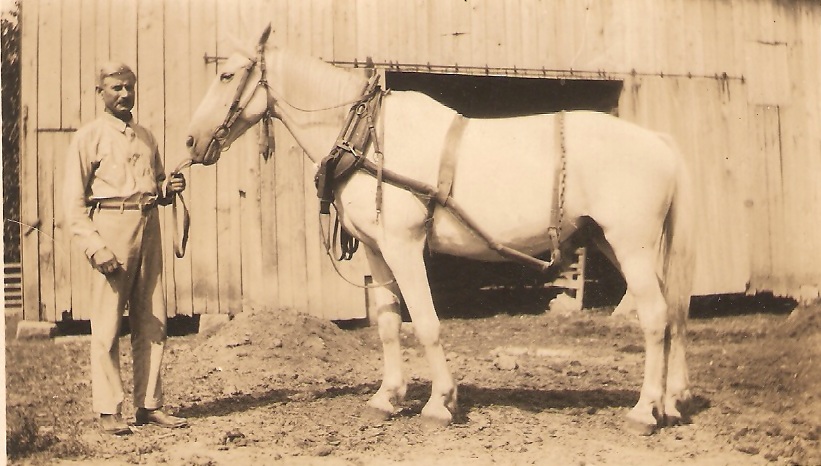
Herman Miller and Rallie in front of the old barn, Bicknell, Indiana, about 1940.

Shortly before 1870, entrepreneur Clinton Firestone of Firestone Tire and Rubber Company fame and family associated himself with George and Oscar Peters, two men who had worked in the leather business.  These brothers had developed a method for building wagons for under $200 each.  With a wealth of resources and the wealth of cash Firestone could provide, the three formed eventually the Columbus Buggy Works.  Ultimately, Eddie Rickenbacker would become associated wiith the automotive side of the business.

The brothers had already made and sold about 100 buggies using wood sawn from around the Ohio Penitentiary - speculatively Ash.  They used their new manufacturing process.  In 1870, the newly formed Iron Buggy, as Firestone and the Peters named it, and opened their business in what Wikipedia has termed "a shanty" at 180 North High Street in Columbus, Ohio.  This location is now in the "Short North" or "Arena District."  Placing a buggy factory in this area was a good idea.  Iron Buggy sold 274 wagons in the first year.    It was a good idea until it burnt down on May 27, 1874.  Then it became better.

An advertisement for the Iron Buggy Company, about 1870.

The business was rebuilt and sold to a Mr. Tuller, proprietor of the Buckeye Buggy Company.  Firestone and the Peter brothers then took the proceeds of the sale and formed two companies: the Columbus Buggy Company and the Peters Dash Company.  These businesses opened on Wall and Locust Streets closer to the railroad freight house.  They came with a line of wagons at several price points as well as add-ons like dashboards, fenders, and so on.  These companies were completely successful and profitable.  But success does not come without price.

The Timken Roller Bearing Axle Company incorporated in St. Louis in 1899.  But the founder, Heinrich (Henry) Timken had been in the spring and suspension business for much longer.  In 1883, Timken filed a $50,000 lawsuit against Firestone and the Peters for patent infringement involving a spring design patented by Timken and used by the Columbus Buggy Company.   Somehow, Studebaker became involved as a litigant and after a long-drawn-out lawsuit, the judgement was against the Columbus Buggy Company for $3,000.  During the process, Firestone and Timken became friends.

Meanwhile, the Columbus Buggy Company grew so that by 1888, its facilities took in an entire city block on Spring Street between High and Wall Streets.  In was the largest buggy producer and began advertising in magazines.  By 1892, the Columbus Buggy employed 1200 workers who produced 100 buggies per day.  The company even had a presence at the 1893 Chicago World's Fair and advertised dealerships in all states.  Just a few years later, it is claimed that one of every six wagons on the road were built by the Columbus Buggy Company.

So, what did Gran'pa Miller get for his money?

I am indebted to Dave and Diane Engles of Engel Coach Shop as well as Rick Bischoff of The Luminary Shoppe to providing both technical and creative direction through their YouTube contributions.  Rick repairs, restores, and replicates oil and candle lanterns used on wagons and coaches in the era.  Some of his work has been available in nearby Millersburg.  Dave is a qualified wainwright and wheelwright, famous for his reproduction of the 20-Mule-Team Borax Wagons and has also restored a two-seat wagon.  Today, we might interpret a two-seater as a left and right bucket seat in a sports car, but in those days a two-seater meant front and back bench seats, much like a modern four-door town car.  Then, for comfort over unimproved roads, springs were added.  With this wagon, Gran'pa Miller could take his wife and daughter to all-day church service at the Mariah Creek Baptist Church with room for a picnic basket, blankets, and possibly some chairs or other supplies they might need.  Thanks to Dave Engels, I can envision Herman Millers trusty horse and wagon hitched to a rail and two proud parents watching their daughter play in the rich shade grass under cool, leafy trees, with Mariah Creek babbling in the background.  This is a day that memories are made of.  I would also invite everyone to check out Dave Engel's enormous video library on YouTube at Engels Coach Shop as well as the Luminary Shoppe on YouTube to learn more about the Horse-and-Buggy Days.

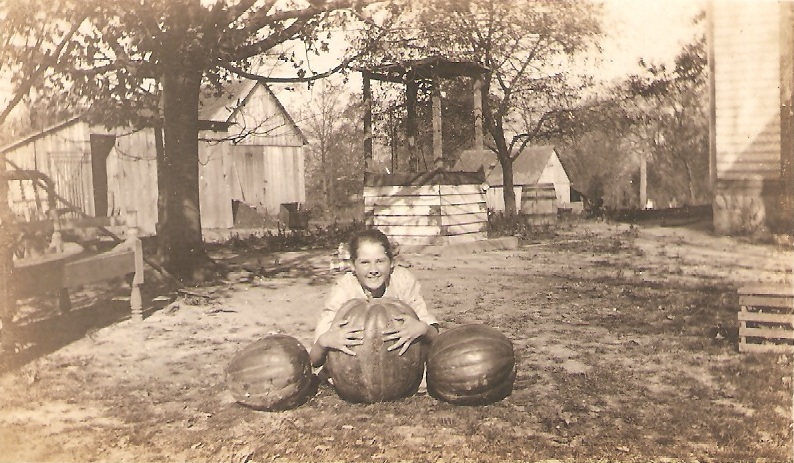
Herman's daughter and her pumpkins on the Miller farm.

With the advent of the horseless carriage, the Columbus Buggy Company would try to enter the fledgling automotive industry and shortly failed.  Dave and Rick have more business than anticipated.  Herman's daughter would learn to drive the buggy, and please don't tell anyone, Gran'pa Miller taught his daughter to drive a car.  (Women weren't allowed back then.)  Gran'pa Miller would turn his farm over to his son-in-law who, in turn, bought a tractor.  For the Millers, the Horse-Drawn Era was over.

Herman, his daughter, and an unknown Miller cousin meet the farm wagon coming home.